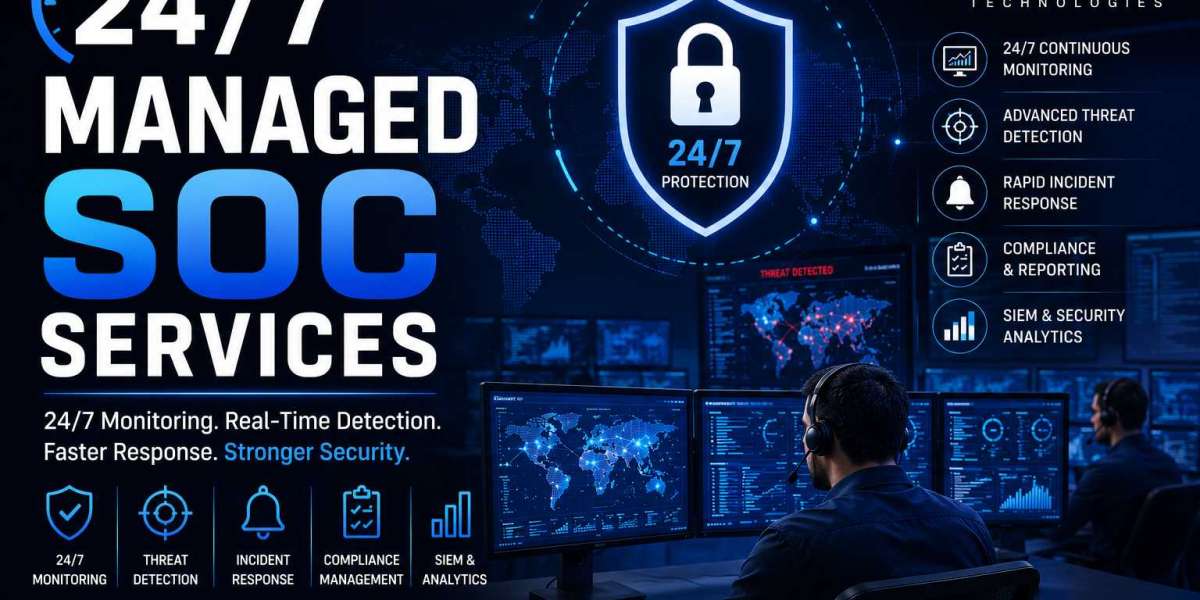
Choosing 24/7 Managed SOC Services for Growing ICT Operations in India
For Indian ICT companies, 24/7 Managed SOC Services provide continuous security monitoring, threat detection, investigation, and incident response through an external security operations model. This approach can extend internal IT capabilities without requiring the company to build every monitoring function, specialist role, security platform, and operating shift itself.
The decision facing ICT security teams
Operational pressure: ICT companies often manage customer platforms, connectivity, cloud environments, applications, infrastructure, and support operations at the same time. Security monitoring must fit around these responsibilities without creating another isolated operational function.
When assessing a soc service provider vs in house SOC for ICT companies in India, leaders should compare responsibilities and operating models rather than treating outsourcing as simply a technology purchase.
Internal ownership: An in-house SOC gives the organization direct control over staffing, technology, procedures, and security data. A managed model places defined monitoring and response responsibilities with an external team while the customer retains governance and business accountability.
Neither model removes the need for internal ownership. The important question is how security responsibilities should be divided.
Where an in-house SOC demands more from ICT teams
Staffing requirements: Continuous security operations require more than one analyst working during business hours. Organizations need coverage for shifts, leave, escalation, investigation, management, and specialist expertise.
Technology management: An internal operation may also require SIEM, endpoint security, network monitoring, log management, integrations, dashboards, detection rules, and ongoing maintenance.
Process maturity: Tools alone do not create an effective SOC. Internal teams need defined alert triage, investigation, escalation, incident response, documentation, and review processes.
For an ICT company whose primary business is delivering technology services, these responsibilities can compete with engineering, infrastructure, customer support, and product priorities.
What a managed SOC changes
Shared responsibility: A managed SOC can provide monitoring and security expertise while the ICT organization retains authority over its environment, users, applications, and business decisions.
Continuous operations: The external team can monitor agreed security telemetry beyond the internal team's normal working hours. This creates a structured route for investigating suspicious events when the internal team is unavailable.
Specialist access: A managed model can provide access to security analysts and established processes without requiring the customer to recruit every specialist role internally.
What should an soc service provider vs in house SOC for ICT companies in India comparison cover?
The comparison should examine staffing, technology ownership, monitoring coverage, incident responsibilities, integration effort, governance, scalability, and internal workload. It should also identify which activities remain with the ICT company after a managed service is introduced.
Area | In-house SOC | Managed SOC |
Staffing | Internal recruitment and management | External security operations team |
Monitoring | Operated by internal personnel | Performed under an agreed service model |
Technology | Customer-owned or managed | Provider-managed or integrated with customer tools |
Escalation | Internal procedures | Defined customer-provider workflow |
Scaling | Depends on internal resources | Can be expanded through the service model |
Governance | Direct internal control | Shared operational responsibility |
Why the ICT environment needs a different approach
Customer environments: ICT organizations may support multiple customers with different architectures, access models, and security requirements. Monitoring therefore needs clear separation of environments and carefully defined escalation paths.
Hybrid infrastructure: Applications and services may span data centers, endpoints, cloud platforms, network infrastructure, and third-party systems. Security visibility should cover the parts of the environment that matter most to the business.
Privileged access: Administrators and support personnel may have elevated access across critical systems. Unusual authentication, unexpected privilege use, or abnormal administrative activity can require investigation.
How to evaluate the operating model
Start with scope: Document which assets require monitoring, which events are considered critical, and which systems require immediate escalation.
Define authority: Establish who can investigate, isolate an endpoint, disable an account, change a security rule, or approve containment. Ambiguous authority can slow incident handling.
Test integration: The SOC should fit existing ticketing, identity, endpoint, network, cloud, and incident-management processes where appropriate.
Review reporting: Security leaders should receive useful information about alerts, incidents, recurring patterns, unresolved risks, and operational actions rather than excessive technical noise.
Is a soc service provider vs in house SOC for ICT companies in India better for hybrid environments?
The answer depends on the company's existing capabilities, governance model, infrastructure complexity, and desired level of operational control. A managed approach can extend monitoring across hybrid environments, while an in-house model may suit organizations that already maintain the people, processes, and technology required for continuous security operations.
A practical transition path
Map dependencies: Identify critical applications, infrastructure, customer-facing systems, privileged accounts, and major data flows before onboarding monitoring.
Prioritize telemetry: Start with security data that supports important detection use cases. More logs are not automatically more useful if they cannot be analyzed effectively.
Create escalation rules: Define severity levels, response contacts, notification channels, and approval requirements before an incident occurs.
Tune detection: Review recurring alerts and false positives with the SOC team. Detection should reflect the organization's architecture and normal operating behavior.
India-specific operating considerations
Regulatory alignment: Depending on the organization's activities and data responsibilities, Indian ICT companies may need to account for requirements involving incident handling, logging, security controls, and data protection.
Contractual security: ICT providers may also have security commitments to customers. The SOC operating model should support those commitments while clearly separating customer responsibilities from provider responsibilities.
How does a soc service provider vs in house SOC for ICT companies in India decision affect internal IT teams?
A managed model can reduce the amount of continuous monitoring work handled directly by internal IT personnel, but it does not eliminate their role. Internal teams still need to manage business context, access decisions, infrastructure changes, incident approvals, and broader security governance.
Questions to settle before signing
Service boundaries: Ask exactly what the SOC monitors, investigates, reports, and escalates. Avoid relying on broad descriptions of “complete protection” without operational definitions.
Response authority: Confirm what the provider may do independently and what requires customer approval.
Onboarding effort: Understand the integrations, access permissions, log sources, documentation, and internal resources required to begin service.
Ongoing governance: Establish regular reviews so that monitoring remains aligned with infrastructure changes, new applications, customer requirements, and evolving security priorities.
Frequently asked questions
Can an ICT company use a managed SOC alongside internal security staff?
Yes. A managed SOC can operate as an extension of an internal team when responsibilities, escalation paths, and authority are clearly defined.
Does outsourcing a SOC remove internal security responsibility?
No. The organization remains responsible for governance, business decisions, access management, and actions that are assigned to its internal teams.
What should ICT leaders ask a managed SOC provider before onboarding?
They should ask about monitoring scope, analyst involvement, escalation, incident response, integrations, reporting, responsibilities, onboarding requirements, and ongoing service reviews.
IBN Technologies provides managed SOC capabilities that organizations can evaluate alongside their existing ICT security operating model.
Contact Us
IBN Technologies
Phone: +91 20 6768 0404
Email: sales@ibntech.com