The Automated External Defibrillators Market is expanding as healthcare providers, public safety organizations, and private institutions increasingly prioritize emergency cardiac care and sudden cardiac arrest response. Automated external defibrillators (AEDs) are portable medical devices designed to analyze heart rhythms and deliver an electric shock when necessary to help restore a normal rhythm during sudden cardiac arrest.
Automated External Defibrillators Market Overview
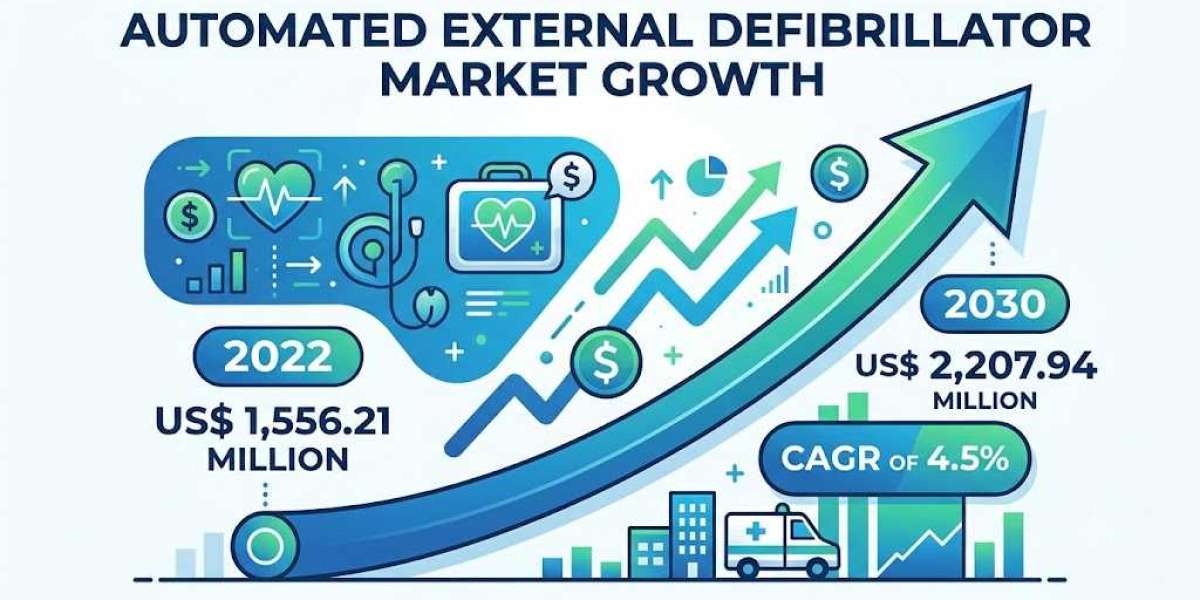
The automated external defibrillator market size is projected to grow from US$ 1,556.21 million in 2022 to US$ 2,207.94 million by 2030; the market is estimated to record a CAGR of 4.5% from 2022 to 2030.Growing awareness of early defibrillation, increasing initiatives to improve public access to emergency medical equipment, and advancements in portable cardiac technologies are supporting market development. Furthermore, the installation of AEDs in airports, educational institutions, workplaces, sports facilities, and public spaces is strengthening demand for accessible life-saving devices.
Download Sample PDF: https://www.theinsightpartners.com/sample/TIPRE00018785
Automated External Defibrillators Market Growth Drivers
The increasing focus on improving survival rates following sudden cardiac arrest is a major factor driving the Automated External Defibrillators Market. Rapid access to defibrillation, combined with cardiopulmonary resuscitation (CPR), can be critical before emergency medical services arrive. Public health campaigns, workplace safety programs, and community training initiatives are encouraging organizations to install AEDs and train personnel in their use. Healthcare facilities are also investing in advanced emergency response equipment to strengthen cardiac care capabilities. In addition, government initiatives and public access defibrillation programs are increasing awareness of AED availability and encouraging wider deployment in high-traffic locations.
Automated External Defibrillators Market Trends
The Automated External Defibrillators Market is witnessing technological developments focused on portability, connectivity, ease of use, and device readiness. Manufacturers are introducing AEDs with voice instructions, visual prompts, automated rhythm analysis, and features designed to guide users with limited medical training. Improvements in battery performance, electrode pad design, and device monitoring are helping organizations maintain operational readiness. Connected AED systems can support remote status monitoring and maintenance notifications, helping users identify devices that require attention. Furthermore, growing interest in smart emergency response networks is encouraging the integration of AED location information with public safety systems and emergency dispatch services.
Automated External Defibrillators Market Segmentation
The Automated External Defibrillators Market can be segmented by product type, end user, and geography. By product type, the market includes fully automated and semi-automated external defibrillators. Based on end user, hospitals, emergency medical services, public access locations, educational institutions, workplaces, sports facilities, and other commercial establishments represent important customer groups. Public access AEDs are particularly relevant in locations where sudden cardiac arrest may occur outside a hospital setting. Market demand across these segments depends on emergency preparedness policies, device costs, training availability, maintenance requirements, and awareness of sudden cardiac arrest response.
Automated External Defibrillators Market Regional Analysis
North America represents an important region for the Automated External Defibrillators Market due to established emergency medical services, public access defibrillation initiatives, and growing awareness of cardiac emergencies. The United States contributes to regional demand through AED deployment in public buildings, workplaces, educational institutions, and sports venues. Europe also represents a significant market, supported by emergency response programs and efforts to improve public access to life-saving equipment. Meanwhile, Asia Pacific offers growth opportunities as healthcare infrastructure expands, awareness of sudden cardiac arrest increases, and public safety programs develop. Regional adoption depends on regulatory requirements, procurement budgets, emergency response capabilities, and access to CPR and AED training.
Automated External Defibrillators Market Key Players
Major companies operating in the Automated External Defibrillators Market include:
Shenzhen Mindray Bio-Medical Electronics Co.
Ltd
Stryker
BPL Medical Technologies Pvt Ltd
Schiller AG
Mediana Co.
Ltd
Nihon Koden Corp
Asahi Kasei Corp
ICU Medical Systems Inc
Progetti SRL
Koninklijke Philips N.V.
Other Market Players
These companies focus on product development, device reliability, user-friendly operation, connected monitoring capabilities, and distribution expansion. Competition is influenced by device performance, ease of use, battery life, maintenance requirements, regulatory compliance, and the availability of training and technical support.
Automated External Defibrillators Market Future Outlook
The future of the Automated External Defibrillators Market is expected to be shaped by increasing investment in public access defibrillation, improvements in emergency response systems, and the growing emphasis on cardiac arrest preparedness. Advancements in connected devices, remote monitoring, and automated guidance may help organizations maintain AED readiness and improve response coordination. Expanding deployment in schools, workplaces, transportation hubs, sports facilities, and community settings may create further opportunities for manufacturers. However, device costs, maintenance needs, limited public awareness, and insufficient training may affect adoption in some areas. Overall, growing recognition of the importance of early defibrillation and accessible emergency equipment is expected to support the market's long-term development.
Related Reports
Thermal Analysis Market Statistics, Trends, Size, Share, Analysis, Key Players by 2031
Basal Insulin Market Share, Growth Demand by 2034
About US
The Insight Partners provides comprehensive syndicated and tailored market research services across the healthcare, technology, and industrial sectors. The company delivers market intelligence and strategic insights to help organizations understand emerging trends, identify growth opportunities, and make informed business decisions in rapidly evolving markets.
Contact Us:
Contact Person: Ankit Mathur
E-mail: sales@theinsightpartners.com
Phone: +1-646-491-9876
Also Available in : Korean German Japanese French Chinese Italian Spanish