
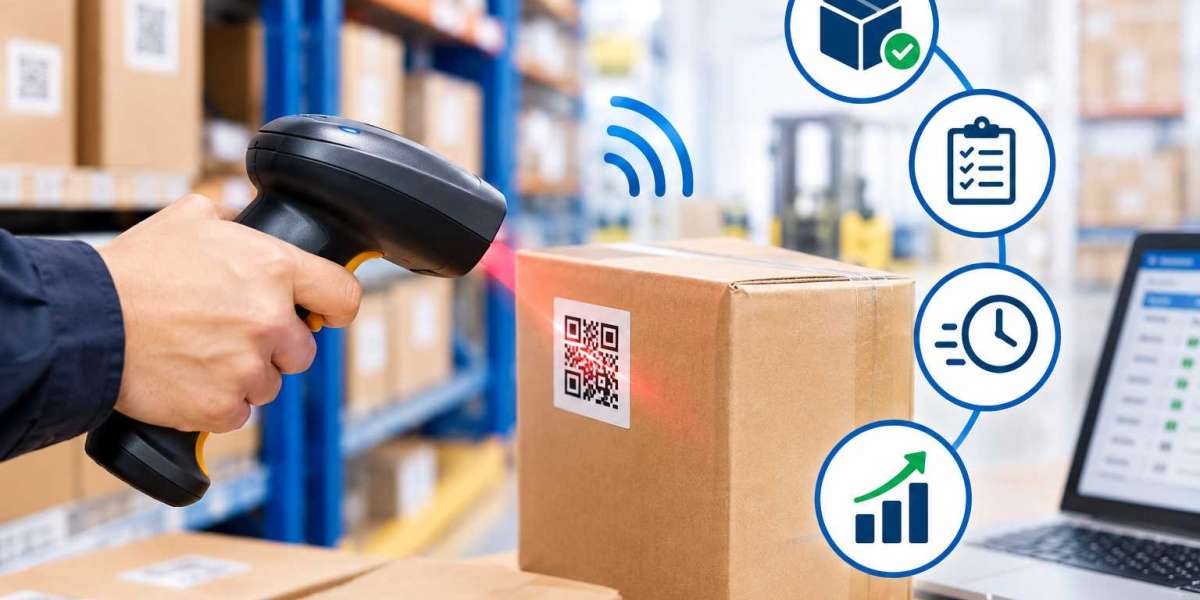
Accurate inventory management is essential for businesses that want to reduce errors, control costs, and maintain efficient operations. From retail stores and warehouses to manufacturing facilities, companies need reliable tools to track products, monitor stock levels, and process inventory movements quickly. Wireless 2D barcode scanners help businesses achieve these goals by capturing barcode data efficiently and transmitting it to connected inventory systems.
Unlike traditional wired scanners, wireless models provide greater mobility, allowing employees to scan items without remaining connected to a computer. They can also read both 1D and 2D barcodes, including QR codes, depending on the device's capabilities.
Businesses exploring wireless 2d barcode scanner buy kuwait options can benefit from understanding how these devices improve daily inventory processes. With support from Pointus Solutions, organizations can explore barcode scanning equipment and compatible labeling supplies suited to their operational requirements.
Table of Contents
What Are Wireless 2D Barcode Scanners?
How Do They Improve Inventory Management?
Key Benefits for Businesses
Industries That Benefit from Wireless Scanning
Tips for Choosing the Right Scanner
Frequently Asked Questions
Conclusion and Call to Action
1. What Are Wireless 2D Barcode Scanners?
Wireless 2D barcode scanners are handheld devices that capture information from printed or digital barcodes and transmit the data to a connected system. Depending on the model, they may connect through Bluetooth or proprietary wireless technology to computers, tablets, mobile devices, or compatible terminals.
These scanners can read traditional linear barcodes and two-dimensional codes such as QR codes. This flexibility allows businesses to capture product identifiers and, where encoded, additional information such as batch numbers, serial numbers, or expiration dates.
Because employees can move freely around storage areas, wireless scanners are particularly useful for stocktaking, receiving shipments, picking orders, and transferring inventory between locations.
2. How Do They Improve Inventory Management?
Faster Stock Counting
Manual inventory counting can take considerable time, especially when businesses manage thousands of products. Wireless scanners allow employees to scan items quickly and record the results digitally.
This makes routine stock counts more efficient and helps teams complete inventory checks with less manual data entry.
Improved Inventory Accuracy
Typing product codes manually increases the risk of mistakes. Barcode scanning reduces these errors by capturing encoded information directly.
When integrated with inventory software, scanned data can update stock records more consistently, helping businesses maintain accurate inventory information and identify discrepancies sooner.
Real-Time Stock Visibility
Compatible scanners and inventory systems can update stock records as products are received, moved, picked, or dispatched. This gives managers a clearer view of inventory levels and product locations.
Real-time updates depend on the software, network connection, and system configuration, but they can help businesses make better purchasing and replenishment decisions.
Better Warehouse Mobility
Wireless scanning enables employees to move between shelves, storage racks, loading docks, and packing stations without carrying a wired device or repeatedly returning to a workstation.
This flexibility can streamline warehouse workflows and reduce unnecessary movement during daily operations.
Faster Order Picking and Fulfillment
Warehouse staff can scan products during order picking to confirm that the correct items and quantities have been selected. Scanning at packing and dispatch stages can provide additional verification.
These checks help reduce picking errors, incorrect shipments, and avoidable returns.
Easier Tracking of Batches and Serial Numbers
When businesses use suitable 2D barcodes and compatible software, they can capture batch numbers, serial numbers, and other encoded details. This supports traceability, product recalls, warranty management, and quality control.
3. Key Benefits for Businesses
Wireless 2D barcode scanners offer several practical advantages:
Greater productivity: Employees can scan inventory without being restricted by cables.
Fewer manual errors: Direct data capture reduces reliance on handwritten records and manual typing.
Improved stock control: More consistent records help businesses identify shortages and excess inventory.
Efficient receiving: Staff can verify incoming products against purchase orders or delivery records.
Better order accuracy: Scanning helps confirm items before they are packed and shipped.
Scalable operations: Businesses can add compatible scanners as their inventory and workforce grow.
The overall improvement depends on selecting suitable hardware and integrating it with well-designed inventory processes.
4. Industries That Benefit from Wireless Scanning
Retail Stores
Retailers can use wireless scanners for stock counts, shelf replenishment, price checks, and backroom inventory management. Faster scanning helps staff spend less time on administrative tasks.
Warehouses and Distribution Centers
Warehouse teams can scan goods during receiving, put-away, picking, packing, and dispatch. These checkpoints improve inventory visibility throughout the fulfillment process.
Manufacturing Facilities
Manufacturers can track raw materials, work-in-progress items, finished products, and production batches. Scanning can also support component verification and movement between production stages.
Healthcare and Pharmaceuticals
Healthcare suppliers and pharmaceutical businesses can use compatible barcode systems to track products, batches, and expiration dates. Appropriate processes and software are essential for accurate traceability.
5. Tips for Choosing the Right Scanner
Before selecting a device, businesses should consider the following factors.
Barcode compatibility: Confirm that the scanner supports the 1D and 2D barcode formats used in your operations.
Wireless range: Choose a model with sufficient range for your warehouse or retail environment.
Battery life: Look for reliable battery performance for the length of typical shifts.
Durability: Consider resistance to drops, dust, and other workplace conditions.
Software compatibility: Verify that the scanner works with your inventory management system.
Scanning performance: Test it with actual labels, damaged codes, and the scanning distances employees commonly use.
Ergonomics: Select a comfortable model for frequent or extended scanning.
Businesses comparing wireless 2d barcode scanner buy kuwait options should evaluate total operating requirements rather than focusing only on the purchase price.
It is also important to use clear, durable barcode labels. Companies that consume large quantities of shipping and inventory labels may consider a direct thermal labels roll bulk order kuwait option to maintain consistent supplies. Direct thermal labels are suitable for many short-term labeling applications, although their durability depends on exposure to heat, light, friction, and other environmental conditions.
6. Frequently Asked Questions
1. How do wireless 2D barcode scanners improve inventory accuracy?
They capture barcode information directly, reducing manual entry mistakes. When connected to compatible inventory software, they help keep stock records accurate and consistent.
2. Can wireless 2D barcode scanners read QR codes?
Yes. Most 2D barcode scanners can read QR codes and other supported two-dimensional formats, but compatibility should be confirmed before purchase.
3. Do wireless barcode scanners work without an internet connection?
Some models can scan and temporarily store data offline, depending on their design and software. However, updating a cloud-based inventory system may require a network connection or later data synchronization.
4. Are wireless 2D barcode scanners suitable for small businesses?
Yes. Small retailers, workshops, and growing warehouses can use them to simplify stock counts, track products, and reduce manual errors.
5. Do businesses need special labels for 2D barcode scanners?
They need labels with barcodes that the scanner can recognize. Proper barcode size, contrast, print quality, and label placement are important for reliable scanning.
6. Where can businesses find barcode scanning and labeling solutions in Kuwait?
Businesses can contact Pointus Solutions to discuss suitable barcode scanning equipment and labeling supplies based on their inventory processes, device compatibility, and budget.
7. Conclusion and Call to Action
Wireless 2D barcode scanners can make inventory management faster, more accurate, and easier to scale. By reducing manual data entry, improving stock visibility, supporting product traceability, and streamlining warehouse workflows, these devices help businesses maintain better control over their inventory.
The best results come from combining suitable scanners, reliable barcode labels, compatible inventory software, and consistent scanning procedures.
If your business is exploring wireless 2d barcode scanner buy kuwait options or planning a direct thermal labels roll bulk order kuwait, connect with Pointus Solutions to discuss the equipment and supplies that fit your operational needs. Choosing the right barcode solution can help improve inventory accuracy and support more efficient business operations.



